 ContactValidate
CVLShippingData & verification
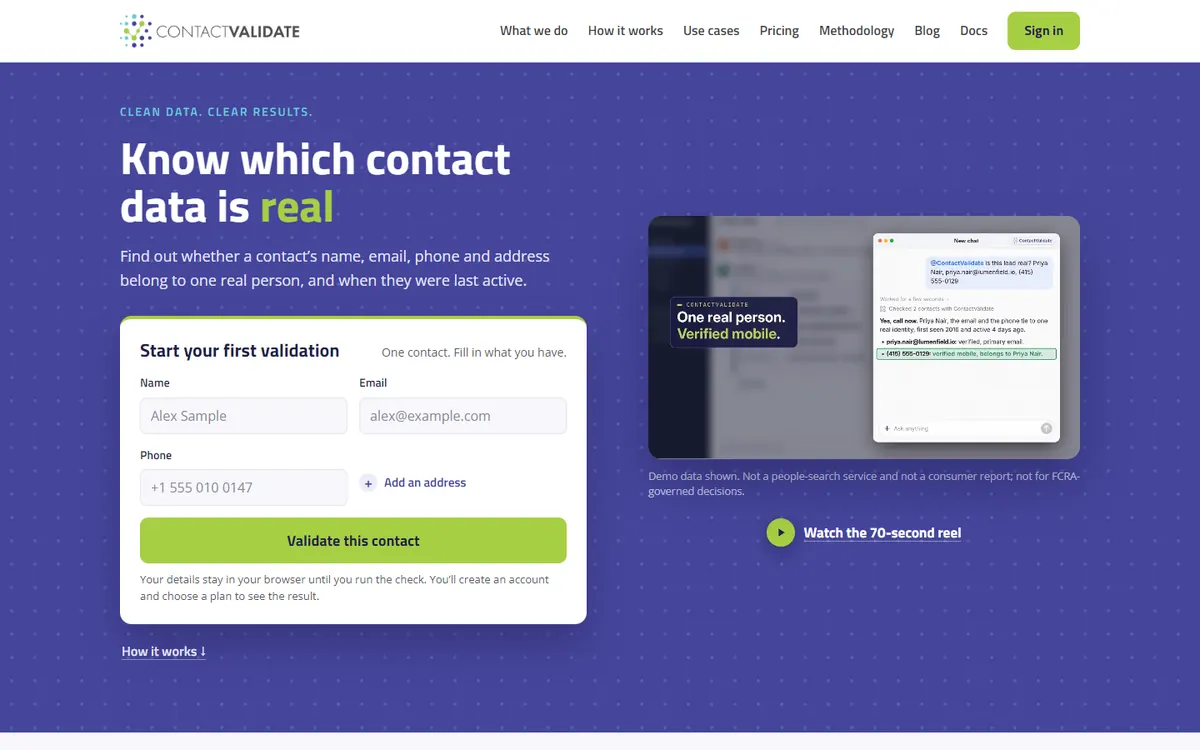
Know which contact data is real.
Your CRM is full of names, emails, phone numbers and addresses. Some are real. Some belong to somebody else. Some were typed by a person who really didn't want your newsletter. ContactValidate tells you which is which.
Works in: Web, API, Claude, ChatGPT
 (opens contactvalidate.com in a new tab)
Give it a name and up to five emails, phones or addresses. It checks whether each one is real, whether they all belong to the same identity, and when that identity was last active. Run it in the web app, through the API, or by asking Claude or ChatGPT.
The robot on ContactValidate
Real email. Real phone. Real address. Same person? I'll be the judge of that.
Built for
- RevOps and marketing ops teams cleaning up lead and customer records.
- Lead generation and collections teams who need to know a contact still holds up.
- Signup and onboarding flows that want to check details as they come in.
- Real estate teams and AI agents that work from contact data they didn't collect themselves.
How it works
- 01
Send a record
A name plus up to five emails, phone numbers or addresses, through the web app, the REST API, Claude or ChatGPT.
- 02
Match it to an identity
A third-party provider matches the details to an identity based on real online activity.
- 03
Get a verdict per field
Each value comes back as Primary match, Secondary match, Different person, Unverified or Unknown.
- 04
See the context
You also get standardized values, a consistency read across the record, and when the identity was first and last seen.
- 05
Scale up with batches
Check up to 500 records at a time. Every batch is quoted before it runs, so you know the cost first.
What it tells you, and what it doesn't
ContactValidate answers one question well: is this contact data real, and does it belong to the person it's filed under? A value flagged as belonging to a different person is usually the most useful thing it can tell you.
It's deliberately narrow. It doesn't hand you a risk or fraud score, and it doesn't test email deliverability or phone line status. And "Unverified" doesn't mean fake. It means the check couldn't confirm it.
Inside Claude and ChatGPT
The ContactValidate connector runs the same checks inside Claude and ChatGPT. Ask whether a contact record holds up, the way you'd ask a colleague, and the assistant runs the check and reports the verdicts.
The same checks are in the web app for people who like buttons, and in the REST API for systems that run them automatically.
Not people search
ContactValidate checks records you already hold. It isn't a people-search tool, it isn't a consumer reporting agency, and its results aren't for employment, credit, insurance or housing decisions.
Pricing
Web app plans: Solo at $19 a month for 25 checks, Team at $99 a month for 175 and Pro at $299 a month for 600. API credits run from 60 credits for $25 down to $0.25 a check at 40,000 credits for $10,000. Every check costs one credit whatever the verdict, failed checks are refunded, and test values are free.
Current prices are on contactvalidate.com.
Questions people ask
What does ContactValidate check?
Whether each email, phone number and address in a record is real, whether they belong to the same identity, and when that identity was first and last seen.
What verdicts can a field get?
Primary match, Secondary match, Different person, Unverified or Unknown. Unverified means the check couldn't confirm the value, not that it's fake.
Does it check whether an email will bounce or a phone line is active?
No. It doesn't test deliverability or line status, and it doesn't produce a risk or fraud score. It checks whether the data is real and belongs together.
How do batches work?
You can check up to 500 records in one batch. The batch is quoted before it runs, so you see the cost before you commit.
Am I charged if a check fails?
No. Failed checks are refunded. A completed check costs one credit whatever the verdict, and test values are free.
What can't I use ContactValidate for?
Screening people. It isn't a consumer reporting agency or a people-search tool, so its results can't be used for employment, credit, insurance or housing decisions.
Read more
- How to check if contact data is realCheck contact data in layers: first that each email, phone number and address is well formed, then that it actually exists, then that all of them belong to the same person. The last step is the one most checks skip, and it's the one that catches made-up and mixed-up records.
- What is an MCP connector, and should you trust one?An MCP connector plugs an outside service into an AI assistant like Claude or ChatGPT, so the assistant can look things up or take actions in that service for you. MCP stands for Model Context Protocol, an open standard for those connections. Before you add one, check who runs it, what it can change, how it charges and whether it asks before acting.
Details checked against contactvalidate.com on November 28, 2026.
More from the shop

PersonIQ
Person and property search, in your browser or inside Claude and ChatGPT.
Works in: Web, Claude, ChatGPT

WhosCalling
Find out who's calling before you pick up.
Works in: Web

TrustMatch
Verify someone you met online before you meet in person.
Works in: iOS, Android, Web, API